The AI management system for the EU AI Act and ISO 42001
Inventory every AI system, classify it under the AI Act, run impact assessments and keep the evidence an auditor asks for, in one workspace. Built in Cologne for teams that have to show their work.
Every entry links to its risk assessment, controls and audit trail.
Illustration of the AIMS AI system register
Built for Regulation (EU) 2024/1689
Aligned with ISO/IEC 42001:2023
Data stored in the EEA
Google for Startups Cloud Program
How AIMS works
From AI inventory to audit evidence
The AI Act and ISO/IEC 42001 ask the same underlying question: do you know what AI you run, what risk it carries, and can you prove you control it? AIMS turns that into five steps.
01
Register
Build one inventory of every AI system and model you develop, buy or embed, with owners and intended purpose.
ISO 42001 cl. 4.3 · AI Act Art. 49
02
Classify
Determine your role and each system's risk class: prohibited, high-risk, transparency or minimal.
AI Act Art. 5, 6, 50
03
Assess
Run AI risk and impact assessments, including fundamental rights impact assessments, with the right stakeholders.
ISO 42001 cl. 6.1, A.5 · AI Act Art. 27
04
Control
Map Annex A controls and AI Act requirements to owners, policies and evidence, and track the gaps.
ISO 42001 Annex A · AI Act Art. 9–15
05
Audit
Run internal audits and management reviews, and export the documentation an assessor will ask for.
ISO 42001 cl. 9.2, 9.3
Two products, one record
Govern the AI you have. Govern the AI you build next.
AIMS is the system of record for AI governance. Arelis Hub is the gateway your teams use to build with models, and it reports into AIMS.
AI management system
AIMS
For compliance, risk and data protection teams running an AI governance programme against ISO/IEC 42001 and the EU AI Act.
AI system inventory and AI Act risk classification
AI and fundamental rights impact assessments
ISO 42001 Annex A controls library and Statement of Applicability
Internal audits, management review and evidence export
From the author of the ISO 42001 Implementation Playbook
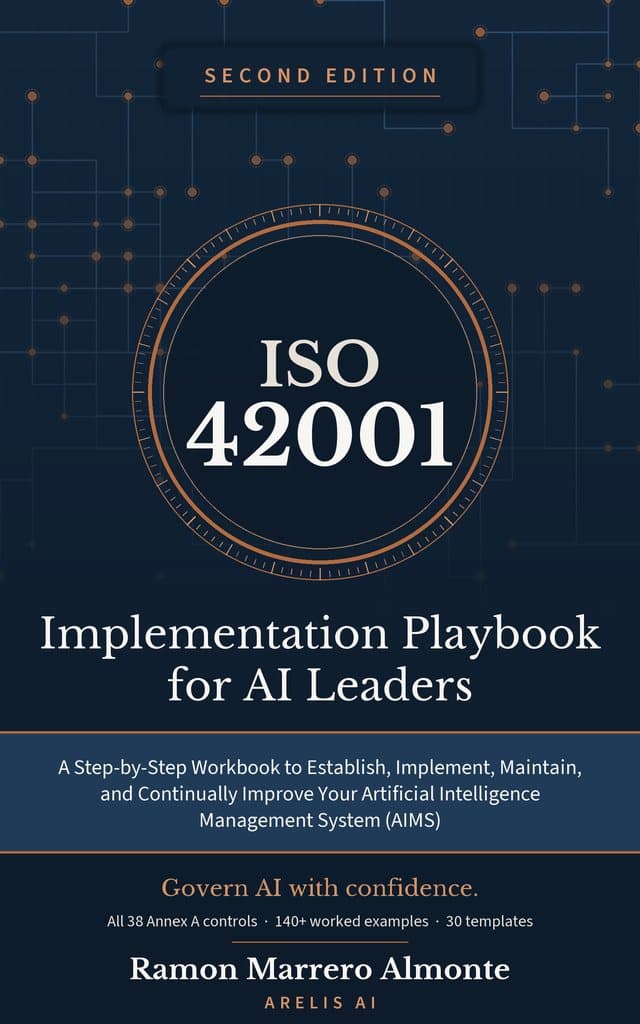
Arelis AI was founded by Ramón Marrero, author of the ISO 42001 Implementation Playbook for AI Leaders, which walks through every clause of the standard and all 38 Annex A controls.
The team behind AIMS has spent more than a decade building data and AI platforms in production. We built the tool we wanted when we had to evidence AI governance ourselves.
The Digital Omnibus moved the high-risk deadline to December 2027, and a lot of teams heard 'the AI Act is delayed'. Three sets of obligations did not move. Here is what actually applies in August, and what it means for your roadmap.
Within a single week, Anthropic and Google released their most powerful AI models yet. Here's what enterprise leaders need to know about Claude Opus 4.5 and Gemini 3—and how to govern these increasingly capable systems responsibly.
The EU has pushed back full implementation of high-risk AI rules to December 2027. What this means for businesses, compliance strategies, and the future of AI regulation in Europe.
Ramón Marrero
FAQ
Questions teams ask before they start
What is an AI management system (AIMS)?
An AI management system is the set of policies, roles, processes and records an organisation uses to govern its AI responsibly. ISO/IEC 42001 is the international standard that specifies one. Arelis AIMS is software for running it: the inventory, assessments, controls, audits and evidence in one place.
Does using AIMS make us ISO 42001 certified or AI Act compliant?
No software can do that on its own. Certification is granted by an accredited certification body after an audit, and AI Act conformity depends on your systems and processes. AIMS helps you build the management system and keep the evidence those assessments ask for.
Which AI Act obligations apply today?
Already in force: Prohibited practices (Art. 5); General-purpose AI models (Art. 51–56); Transparency obligations (Art. 50). Still to come: High-risk systems (Annex III) (Art. 6–49, Annex III) from 2 December 2027; High-risk AI in regulated products (Annex I) (Art. 6(1), Annex I) from 2 August 2028.
Where is our data stored?
Arelis stores primary customer data in the European Economic Area on Google Cloud, and offers a data processing agreement under Art. 28 GDPR. See Trust & security for details.
Is there a free plan?
Yes. The Community plan is free and covers up to three AI systems and three users, including AI Act risk classification and documentation templates.
We are early in our AI governance programme. Where should we start?
Start with an inventory: list the AI systems you build, buy and embed, and classify each one. The free risk classifier and ISO 42001 template pack are designed for exactly that first step.
See your AI governance programme in one place
A 30-minute walkthrough of AIMS with your use cases, the AI Act deadlines that apply to you and what an ISO 42001 audit will ask for.